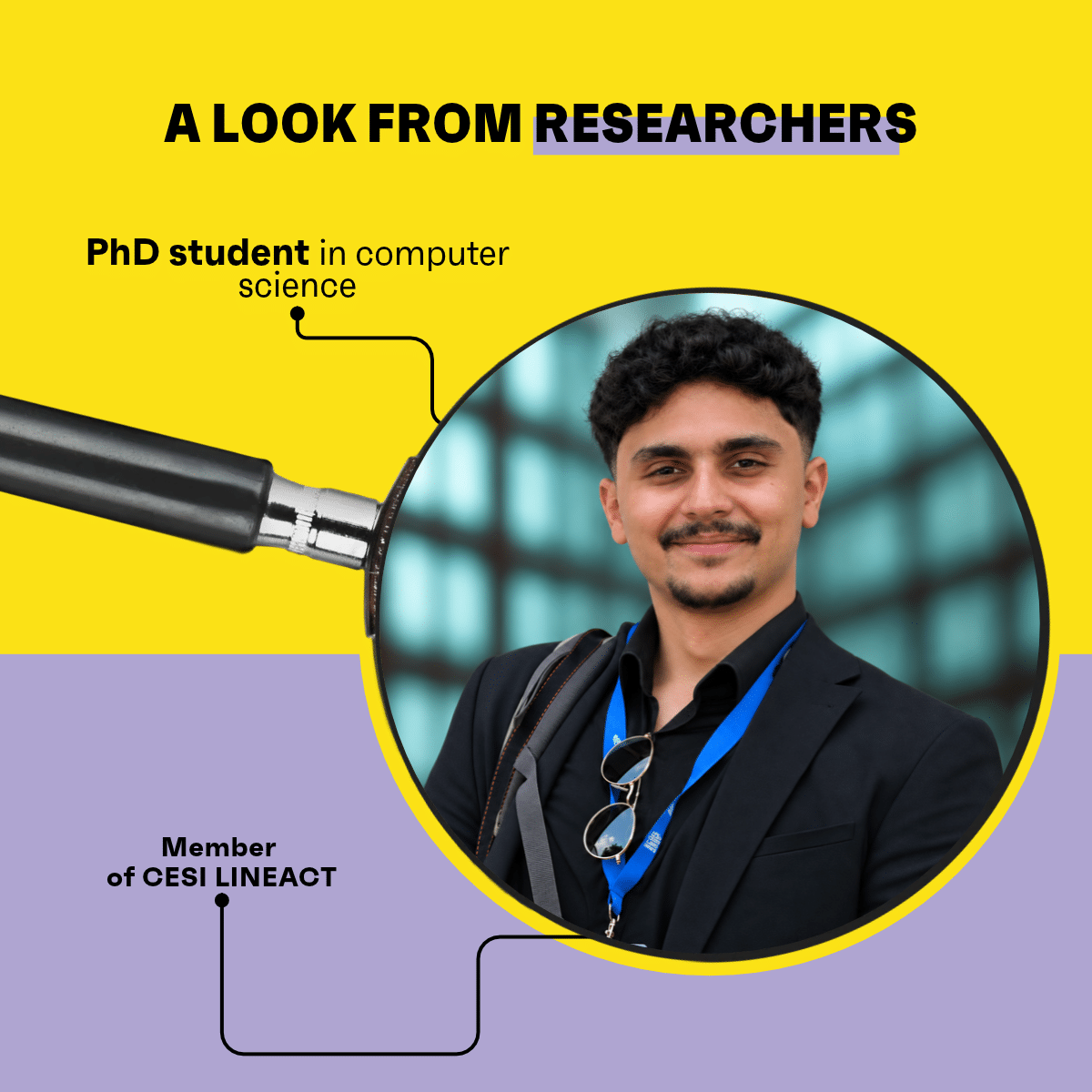
A Look from Researchers with Ahmed-Rafik-El Mehdi BAAHMED
Dans cette page :
- What inspired you to pursue a PhD and explore federated learning and edge computing?
- How does federated learning work, and what challenges does your research aim to address?
- How does your research contribute to the European FAIR’nRG project?
3 questions to Ahmed-Rafik-El Mehdi BAAHMED
PhD student in Computer Science at the CESI LINEACT research unit
Ahmed-Rafik-El Mehdi Baahmed joined CESI LINEACT in Strasbourg in December 2023. His research explores collaborative AI training across connected devices, with an emphasis on keeping locally generated data on the devices themselves. He investigates the performance of federated learning in Edge-Cloud environments, where computing tasks can be handled both locally and remotely.
His aim is to develop approaches suited to different devices, including those with limited computing capacity.
What inspired you to pursue a PhD and explore federated learning and edge computing?
I am convinced that research is one of the driving forces behind progress. Engineering taught me how to design solutions. Research made me want to go further by exploring new ideas and finding ways to turn them into tangible advances. This is what naturally led me to pursue a PhD.
What interests me about federated learning and edge computing is the possibility of bringing AI closer to the devices and people who use it. By enabling devices to collaborate while keeping data where it is generated, we can design models that take into account individual needs and available resources. My goal is to contribute to more efficient and accessible artificial intelligence that gives everyone greater control over their data.
How does federated learning work, and what challenges does your research aim to address?
Imagine several connected devices, each learning from its own data. They then share what they have learned in the form of model updates, while the data used to train the model remains on each device. This is the principle behind federated learning.
The challenge is that these devices differ in their computing power, data and needs. My research, supported by the Grand Est Region, aims to enable these devices to collaborate, including those with limited resources, while reducing the amount of computation required. The idea is to ensure that AI adapts to the capabilities of the devices we use in practice.
How does your research contribute to the European FAIR’nRG project?
Coordinated by CESI École d’Ingénieurs Strasbourg and supported by the Interreg Upper Rhine | Oberrhein programme, the FAIR’nRG project brings together French, German and Swiss partners around a common goal. It aims to improve the production, storage and consumption of solar energy while taking into account differences in installations, usage patterns and regulations across each country.
I contribute to the coordination of the project and bring my expertise in collaborative artificial intelligence. The challenge is to enable several installations to benefit from what others have learned while retaining control over their own data. Each installation can thus adapt its model to its own needs and resources. For me, this is a practical application of my research to photovoltaic energy management.
A final thought from Ahmed-Rafik-El Mehdi :
Thoroughly conscious ignorance is the prelude to every real advance in science.
James Clerk Maxwell