A Look from Researchers – Interview with EL ZAHER JRADI Madeleine
On this page :
- What has marked you in your career and in taking on responsibility for the S3E specialization ?
- How do you manage to balance your teaching duties with your research activities ?
- Your research focuses on the theme Scene Understanding for Human-System Interaction. Which concrete challenges or applications do you find especially promising in this field ?
3 questions to EL KHALFI Zeineb
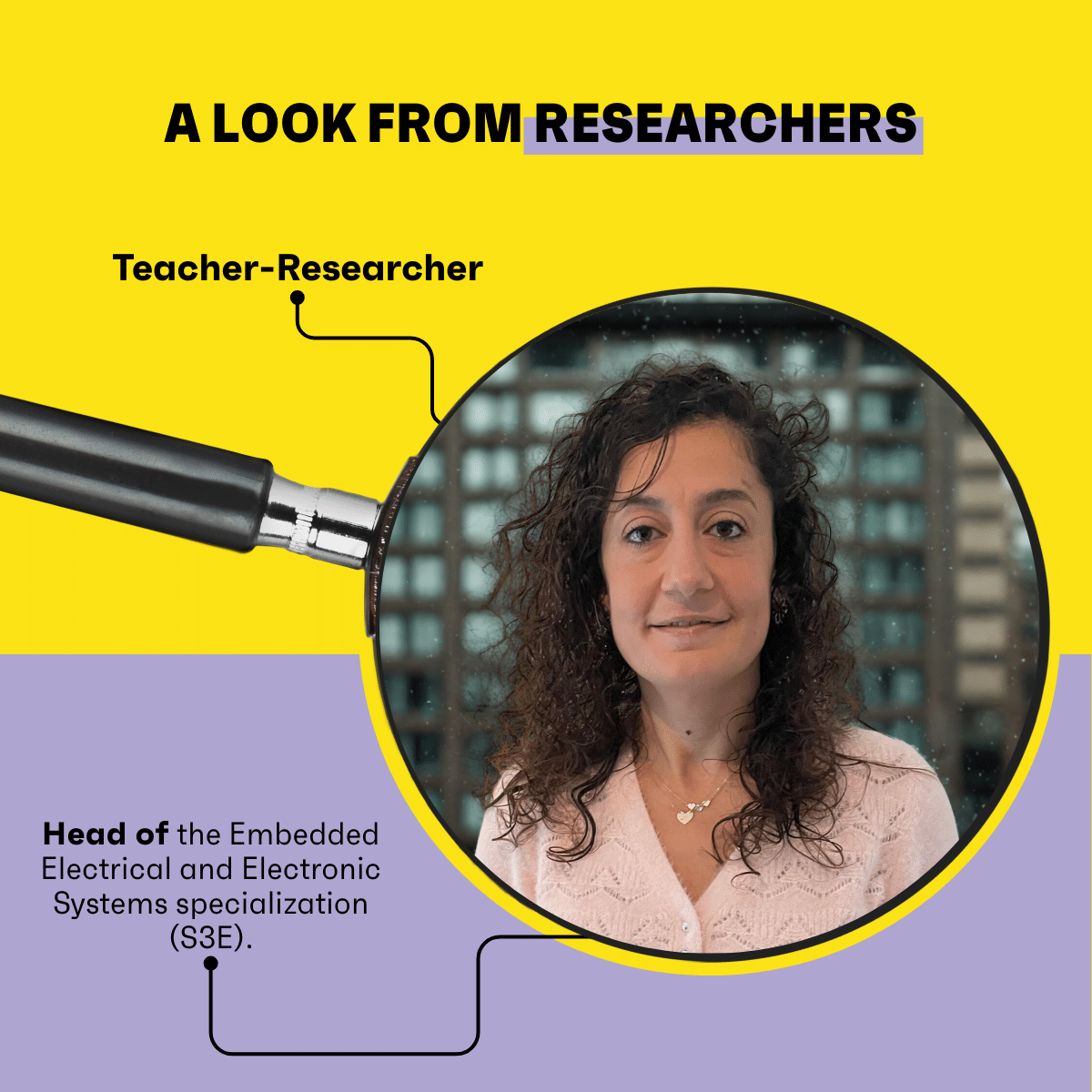
Teacher–Researcher, Head of the Embedded Electrical and Electronic Systems specialization (S3E) and member of the teaching staff of the Directorate of Studies for the Grande École Program at CESI LINEACT
Since joining CESI in 2016 as a teacher-researcher, Madeleine has led the S3E specialization since 2020. She is committed to technological and educational innovation, linking scientific advances, industry needs, and the development of the engineers of tomorrow. At the same time, she continues her research work at CESI LINEACT on the theme of Scene Understanding for Human-System Interaction, with a particular interest in mobile robotics and its integration into industrial environments.
What has marked you in your career and in taking on responsibility for the S3E specialization ?
I joined CESI in 2016 and have led the S3E program since 2020, at a time when it was starting to grow with new openings across several CESI campuses. Embedded electronics is now at the heart of many technological innovations from intelligent transport to robotics and connected objects.
I have had the chance to help shape this specialization, support the evolution of the curriculum, and participate in its rollout across different sites. What has impacted me the most is the collective commitment surrounding this program from the teaching teams to the students, and our industrial and academic partners. It’s both a human and technical adventure, driven by a true shared passion for innovation.
How do you manage to balance your teaching duties with your research activities ?
It’s a demanding but incredibly stimulating balance. For me, teaching and research are inseparable: research allows me to stay at the cutting edge of technological developments and to steer our training programs toward the competencies of tomorrow.
My goal is to offer the best to our students, ensuring the Grande École Program constantly adapts to rapid changes in technical and digital environments. It is also a way to strengthen the connection between knowledge production and its transmission a virtuous cycle that makes the role of teacher-researcher so rich.
Your research focuses on the theme Scene Understanding for Human-System Interaction. Which concrete challenges or applications do you find especially promising in this field ?
My work focuses more specifically on mobile robotics, a field that is rapidly expanding in industrial environments. These autonomous systems pose many technical challenges: perception, mapping, environment understanding, planning, and safe navigation.
The major challenge, in my view, lies in a system’s ability to understand and anticipate human behavior to enable smooth and safe interaction. These advances open the door to more collaborative industrial environments where humans and robots work side by side effectively and securely.
Madeleine’s advice to those embarking on applied research for the industry of the future :
Always keep one foot in the real world. Applied research makes sense when it responds to real needs and relies on exchanges with actors on the ground. By listening to industrial partners and understanding their constraints, we can develop relevant and transferable solutions.
EL ZAHER JRADI Madeleine