BATTL‑EU — Sustainable and Transparent Battery Lifecycle Management through Enhanced Data Tracking and User Privacy in Electric Vehicles/

- Coordinator: University of Valenciennes LAMIH
- Partners: CESI LINEACT, Dunasys, University of Valenciennes (LAMIH)
- Funding: ANR Generic PRCE
- Project budget: €994K
- Project duration: 42 months
Sustainable and transparent battery lifecycle management through enhanced data tracking and respect for user privacy in electric vehicles.
The Battl-EU project responds to the acceleration of the EV market (global demand for batteries +20%/year by 2030, up to $410 billion) and European circularity/traceability requirements, while the average battery life (≈ 8–12 years) is significantly reduced by inappropriate driving and charging behaviors (–20 to –30% of lifespan), recycling remains low in Europe (~5% of Li-ion) and demand for raw materials could increase 20–25-fold by 2030, making reliable traceability essential (Batteries Directive, Green Deal). The literature and industry feedback converge: actual use (driving styles, charging habits and schedules, thermal and network context) has a significant impact on degradation, but remains poorly integrated into current BMS and battery passports, while data protection hinders the detailed exploitation of these factors. To address this, Battl-EU proposes a vehicle-edge-cloud architecture powered by the Dunasys box: onboard data collection, local analysis, and federated learning to account for heterogeneity and privacy (network, profiles, computing power), followed by recording of the battery passport on a permissioned blockchain to ensure integrity, traceability, and interoperability throughout the life cycle.
The objectives are:
- Optimize RUL through behavioral analysis and load planning
- Improving recycling through secure end-to-end traceability
- Ensuring GDPR compliance through decentralized processing
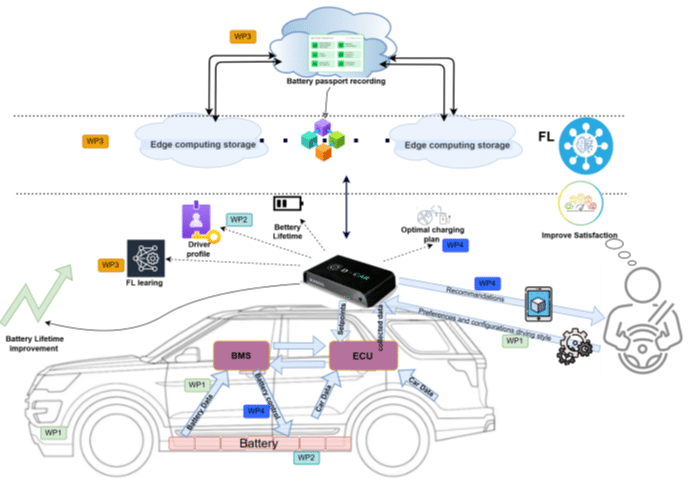
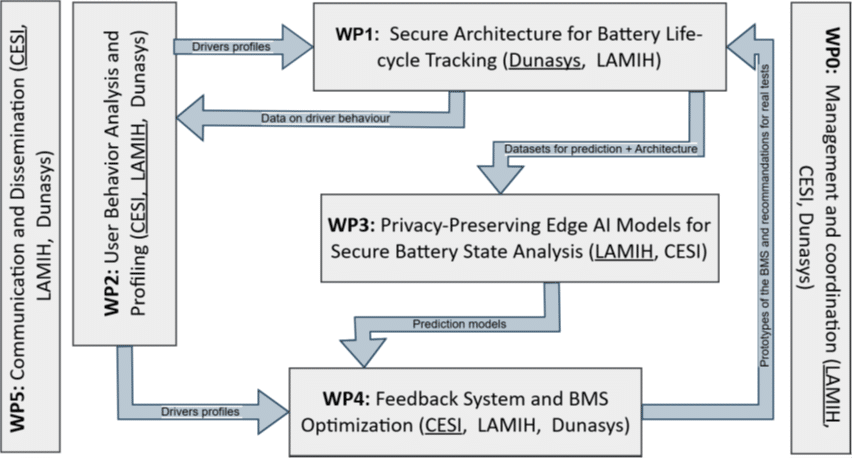
The WP organization covers: WP0 management, WP1 architecture and collection/traceability protocol, WP2 driver profiles and usage modeling, WP3 Federated learning and SoH/RUL models optimized for embedded systems, WP4 recommendation engine and online BMS optimization, WP5 dissemination and acceptability. The consortium brings together LAMIH/UPHF (Edge-AI, privacy, blockchain, driving analysis), CESI LINEACT (optimization, simulation, human-centered approach, fog/cloud), and Dunasys (telematics, field acquisition, box integration).
CESI plays a pivotal role: co-coordination of WP2 (behavioral modeling, usage→degradation coupling, synthetic profiles) and coordination of WP4 (multi-objective scheduling, real-time re-optimization, integration with the twin and BMS), contribution to WP1/3/5, and supervision of a thesis dedicated to load and route planning optimization/recommendation, and involvement in the supervision of the two other theses led by the other partners, ensuring scientific continuity through to the demonstrators and industrial transfer.