ACTING – Advanced laparosCopic TrainINg based on Gesture and posture recognition

- Project partners : CHU Rouen, CESI LINEACT
- Call For Project : Métropole Rouen Normandie
- Total Project Budget : 195 199€
- CESI Project Budget : 180 966€
- Project Start : October 1st, 2025, and will end on September 30th, 2028
- Project Duration : 36 months
Today, minimally invasive laparoscopic surgery is a predominant practice in medicine. All interns are trained in this technique on simulators. However, the quality of their movements, positioning and posture when using laparotrainers cannot currently be reliably assessed due to a lack of dedicated teaching tools.
It is in this context, and with a view to optimising learners’ progress by offering them personalised training programmes, that the ACTING project fits in.
The latter proposes to use artificial intelligence tools to recognise human actions in order to:
- Detect learners’ movements and postures in a laparoscopic procedure training situation using the laparotrainer (laparoscopic surgery training device);
- Evaluate the actions and postures that lead to good performance (and those that lead to poor performance) in relation to commonly recognised and adopted performance standards in the health community;
- Offer personalised recommendations to learners to optimise their progress by providing individualised corrective measures.
Achievements as of 11 February 2026:
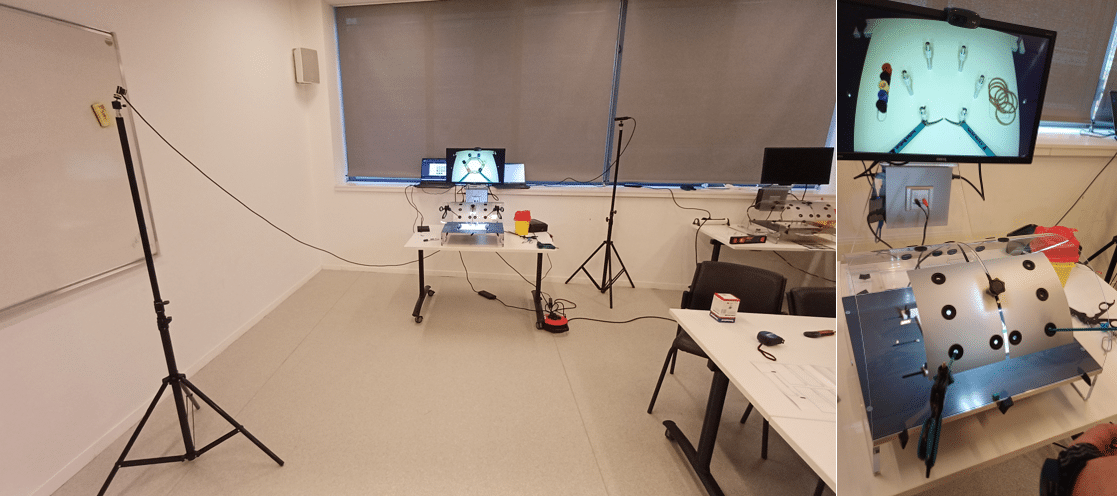
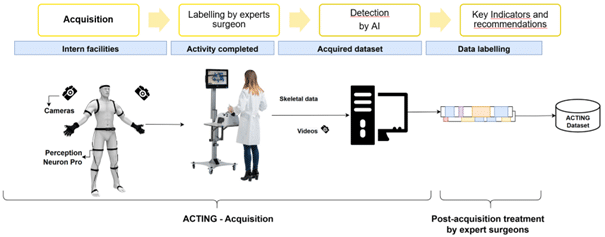
Since the launch of the project, various tasks have been carried out, in particular to define the data acquisition protocol and bring it into line with the standardised assessment grids for young doctors in laparoscopy. As such, the first acquisitions were made in the presence of an expert surgeon and a novice participant. The objective was to collect data from two distinct profiles in order to establish benchmarks for the postures observed. The acquisition system consisted of: a motion capture combination “Perception Neuron”, 2 ZED2 mini cameras (video + depth), a laparotrainer camera recording system.
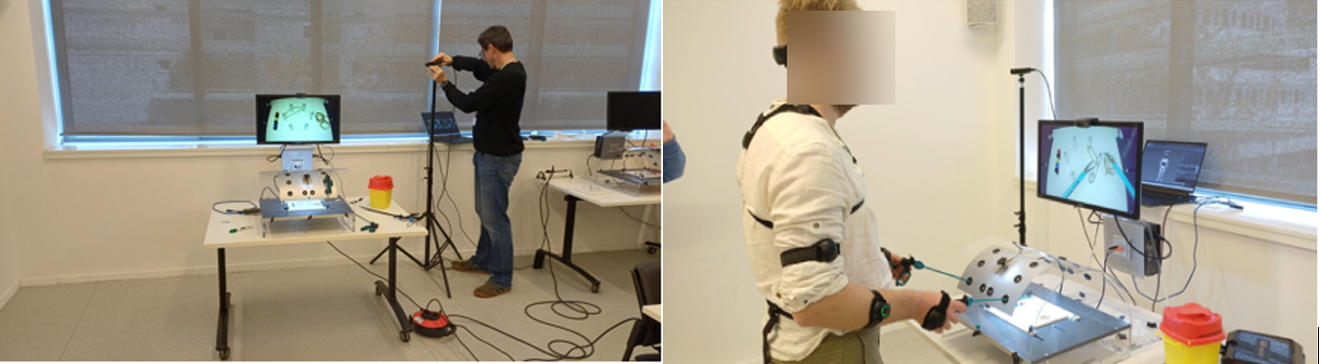
In addition, an observation session was conducted with an audience of young interns from various specialities. This observation session was particularly beneficial in understanding the key information to be extracted in order to evaluate the activity carried out and refine the acquisition protocol, both in terms of the resources used and the types of data collected.
At the same time, a postdoctoral researcher has been recruited and will begin a 30-month contract on 1 April 2026..