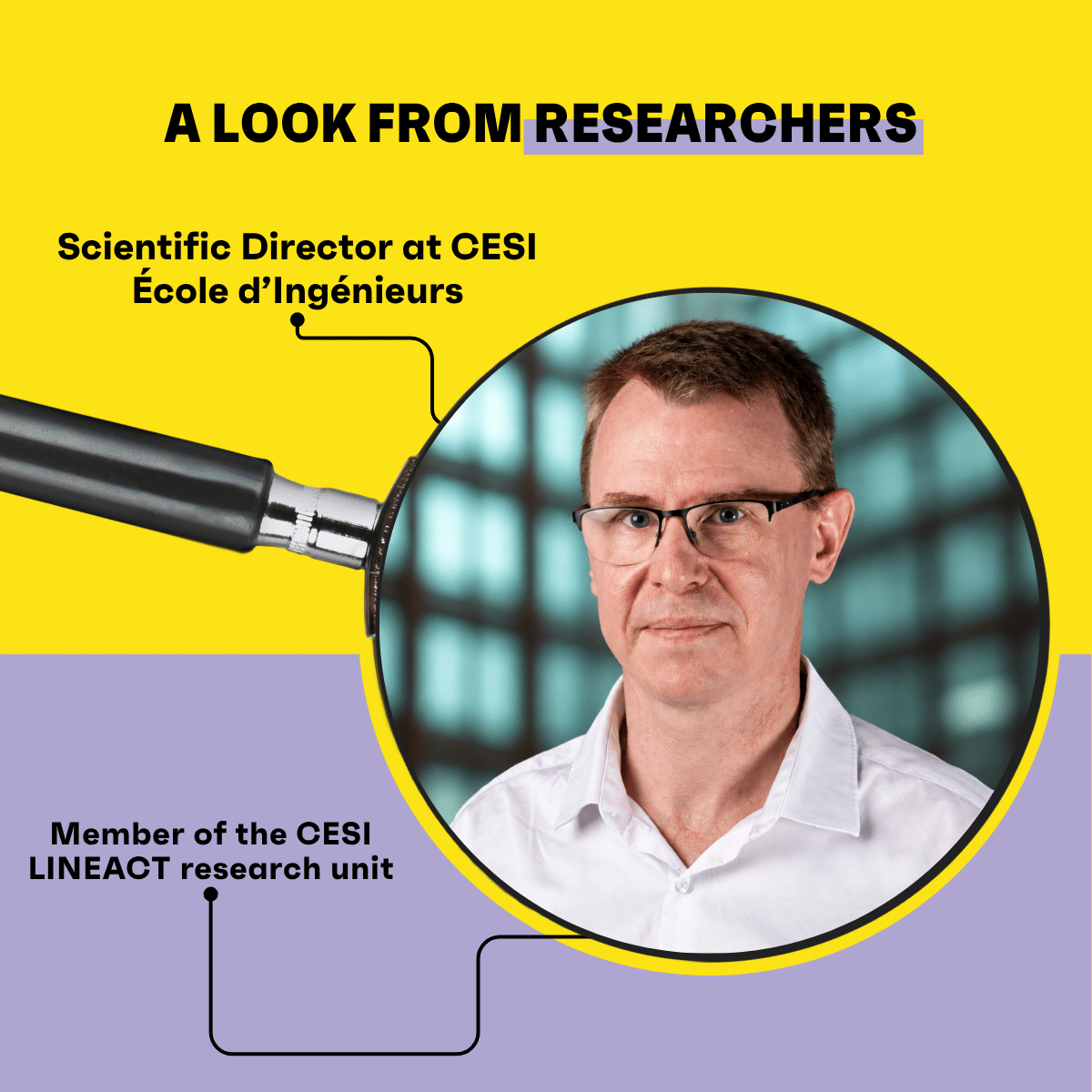
A Look from Researchers with David BAUDRY
On this page :
- What sparked your interest in research ?
- What are your research interests today ?
- What do you see as the major research challenges in the years ahead ?
3 questions to David BAUDRY
Scientific Director at CESI École d’Ingénieurs and member of the CESI LINEACT research unit
David BAUDRY has been Scientific Director at CESI École d’Ingénieurs since 1 July 2026. Within the Research and Innovation Department, he coordinates scientific activities and strategic foresight, and helps shape the scientific roadmap for CESI École d’Ingénieurs and its CESI LINEACT research unit.
Before taking up this role, he led CESI LINEACT’s “Engineering and Digital Tools” research team. He joined CESI École d’Ingénieurs in 2011 as a teacher-researcher.
What sparked your interest in research ?
It began with an internship in a theoretical chemistry research laboratory, followed by my final-year project: a research and development project on image processing applied to concrete. At the time, I was pursuing a dual degree in engineering and a DEA, the equivalent of today’s research master’s degree, in materials science.
After an initial experience in industry as a digital engineer, I joined another engineering school, ESIGELEC, as a research engineer. That was where I really discovered the world of research, particularly in electronics. I then had the opportunity to complete a PhD supervised by Bélahcène while remaining employed there. This led me to specialise in electromagnetic compatibility, particularly near-field phenomena, and then to pursue a career as a teacher-researcher.
This was not a career path I had planned in advance. It took shape gradually through opportunities, encounters and, above all, curiosity. I originally trained as a materials engineer and later worked in computing. It shows that a career can evolve and that it is possible to move into new fields of research.
When I joined CESI École d’Ingénieurs in 2011, I made another shift in focus by helping to establish research in industrial engineering and computer science.
What are your research interests today ?
In 2014, through the supervision of a first PhD project, we began developing research at CESI École d’Ingénieurs on augmented and virtual reality (XR) for industrial applications. This work later expanded into the construction sector.
Our research gradually led us to digital twins. A digital twin might represent a piece of equipment, a production system, a building or a construction site. One of our aims is to connect these digital twins with XR devices so that experts, operators and learners can interact with these environments. This can support remote collaboration, enable people to train safely in digital environments, explore different scenarios and test designs before deploying them in the real world.
Today, our research focuses on how users interact with digital twins, as well as on how they are designed. How can we formalise professional expertise, connect different tools and create architectures that make these solutions genuinely useful in industry, education and other sectors?
There are still several challenges to address, including performance, interaction, digital continuity and the integration of emerging concepts such as multiple digital twins and cognitive digital twins. Another challenge is enabling professionals to incorporate their knowledge and configure these tools without always needing custom software development. That is where low-code and no-code approaches are particularly valuable.
This work has taken shape in projects such as JENII, Jumeaux d’Enseignement Numérique Immersif et Interactif (“Immersive and Interactive Digital Twins for Education”). More than 6,000 CESI students, teachers and researchers have benefited from or contributed to the development of immersive digital twins for two CESI École d’Ingénieurs technology platforms: one focused on Industry 5.0 and the other on metal additive manufacturing.
The work also continues at European level through the Erasmus+ project VLF4EU, Virtual Learning Factory for Europe, and at national level through the Engineering Digital Twin programme, operated by Inria.
What do you see as the major research challenges in the years ahead ?
What motivates me today goes beyond my own research and the work I carry out with fellow researchers. It also includes the development of research activity across CESI École d’Ingénieurs.
We have seen strong growth: more than 100 teacher-researchers and over 65 doctoral students now work across four research departments.
Our aim is to continue developing applied research that serves society and local communities while addressing the major challenges of transition.
We have spoken a great deal about digital transformation, but environmental and energy transitions also present major challenges. These issues increasingly shape our research activities.
Artificial intelligence is another important subject. We are incorporating it into our work on digital twins, but its use also raises essential questions about sovereignty, resource efficiency and ethics.
These are issues we must consider both in our research and in our everyday use of technology.
A final thought from David :
Rigour, curiosity and open-mindedness are, in my view, particularly important qualities in research.
David BAUDRY