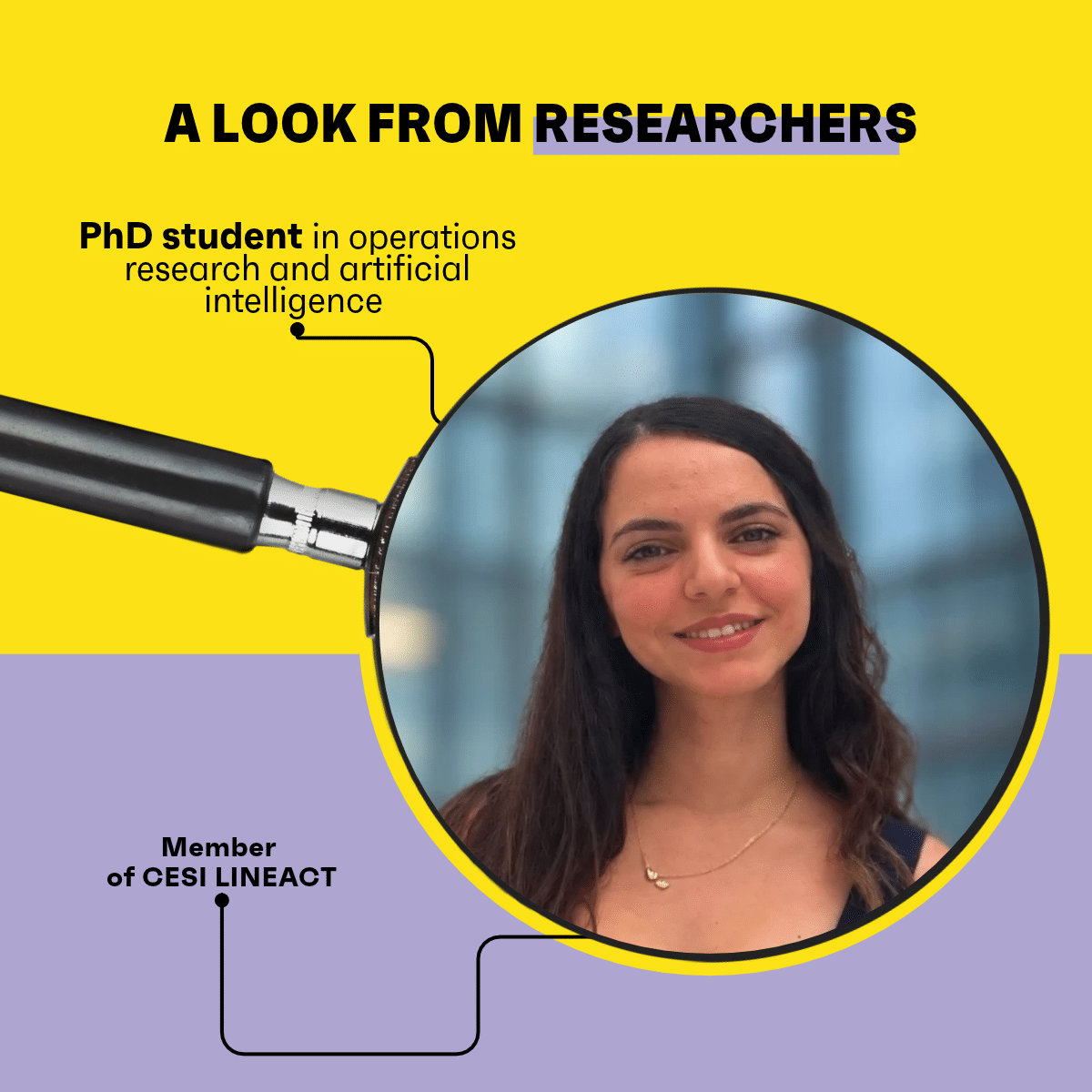
A Look from Researchers with Rékia ABDELLAOUI
Dans cette page :
- What led you to work at the intersection of artificial intelligence, optimisation and sustainable mobility ?
- What specific challenges does your research seek
to address ? - What might the solution emerging from this research look like in the future ?
3 questions to Rékia ABDELLAOUI
PhD student in operations research and artificial intelligence at the CESI LINEACT research unit
Rékia Abdellaoui’s research lies at the intersection of operations research, artificial intelligence and sustainable mobility. As part of Mon Trajet Vert, a programme supported by France’s Energy Savings Certificates (CEE) scheme, she develops optimisation and decision-support methods to offer students multimodal travel options tailored to their needs and constraints.
She joined CESI LINEACT in January 2024.
What led you to work at the intersection of artificial intelligence, optimisation and sustainable mobility ?
My background in artificial intelligence, with a particular focus on algorithms and optimisation, naturally led me towards a topic combining AI, operations research and mobility.
Mobility is a particularly interesting field of research because every decision depends on a wide range of human, technical and environmental constraints. As someone who cares about environmental issues, I found it especially meaningful to put my skills to work on Mon Trajet Vert, a programme dedicated to sustainable student mobility.
I was particularly drawn to this topic because it combines scientific depth with a tangible environmental purpose and a strong human dimension. A PhD involves several years of work, questioning and perseverance. It was therefore essential for me to commit to a meaningful research topic that aligned with both my skills and my values.
What specific challenges does your research seek to address ?
The aim of my research is to bring together several issues that are often studied separately.
These include anticipating public transport delays to suggest more reliable journeys, identifying the best matches between drivers and passengers to facilitate carpooling, and taking into account each student’s preferences, constraints and available transport options.
The challenge is to combine all this information to suggest a journey that truly suits each individual’s circumstances. Ultimately, the goal is to offer students alternatives that are relevant and reliable enough to reduce their reliance on driving alone.
What might the solution emerging from this research look like in the future ?
I envisage a comprehensive mobility assistant, capable of adapting to each student, anticipating disruptions and suggesting alternatives that combine several modes of transport, including carpooling.
This is precisely the ambition behind our work: to move beyond scientific research and deliver a practical solution that people can use directly.
Ultimately, this research is intended to contribute to the development of a mobile app designed to support students in their everyday journeys and make it easier for them to choose suitable, sustainable travel options.
A final thought from Rékia :
Without intellectual curiosity, what would we be? Such is the beauty and nobility of science: an endless desire to push back the boundaries of knowledge, to uncover the secrets of matter and life, without preconceived ideas about the possible consequences.
Marie Curie