Antihpert – operator 4.0 and dynamic anticipation of its disruptions in production workshops


- Partners: CESI, ULHN, and ESIGELEC.
- Call for projects: RIN research
- Total project budget: €385k
- CESI project budget: €155k
- Project launch: October 1, 2021
- Project duration: 42 months
Human-centered production systems represent the new goal of the industrial revolution. It is important to understand human operator behavior and be able to model it in order to design production systems that can understand it, mitigate the effects of its variability, and anticipate its unpredictability.
With this in mind, the AntiHpert project aims to develop approaches based on data and stochastic modeling to improve the functioning of existing enterprise information systems such as ERP and MES, making them more responsive to uncertainty. Implementing this approach will overcome several technological and scientific challenges, which we summarize in the following three steps:
- Minimal and non-invasive detection of disturbances: The objective of this stage concerns the technologies and techniques used to collect data relating to human operators. Two major constraints are associated with these developments, namely invasiveness and cost. These developments are intended for SMEs that cannot afford very high costs and face resistance to change on the part of operators. The system must be capable of detecting signs of a deterioration in quality or operating time ahead.
- Modeling human behavior: In order to anticipate disturbances caused mainly by human operators, it is necessary to define a behavior model specific to each operator, in addition to dynamic behavior models for production tools. It is therefore essential to develop behavior models based on stochastic modeling or artificial intelligence. Several aspects must be taken into account in human operator behavior, such as punctuality, experience, and motivation.
- Proactive actions: Once system drift has been predicted with sufficient accuracy, corrective measures must be put in place to prevent or mitigate these disruptions. Optimal dynamic scheduling algorithms must be developed to propose the next corrective actions. In addition, an intelligent human-machine interface must be developed to facilitate the interpretation of these new scheduling guidelines.
A complementary consortium works closely on these research activities, with several joint actions and frameworks.
Completion by March 31, 2025 (project completion):
Since April 2024, the CESI LINEACT team, together with the AntiHPert consortium, has reached the final milestones of its program, transforming the testing platform, scientific methods, and partnership organization to conclude the project while preparing for its continuation. The work carried out during this period can be summarized as follows:
- Improvement of use cases & data collection
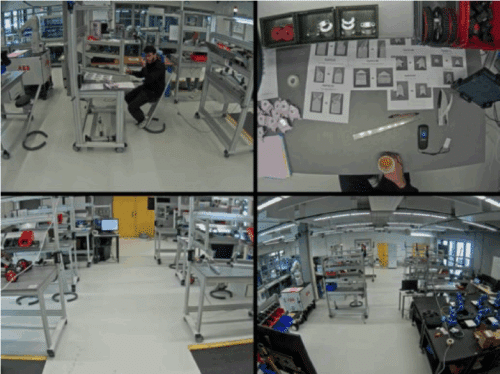
o The enhanced Origami-Lego line, coupled with the Simbot maintenance scenario, is now equipped with eight IP cameras, a HoloLens 2 headset, and the Odoo module, which continuously record operation timestamps, operator IDs, and associated video streams. This system has already produced more than 15 hours of perfectly synchronized footage and some 33,000 usable events from successive test campaigns.
- State of the art
o We conducted a systematic review of the integration of the human factor into scheduling models (stochastic and deterministic), resulting in a meta-model of operator behavior. This analysis highlights four priority areas: leveraging AI for human variability, expanding optimization objectives (ergonomics, energy, productivity, etc.), diversifying modeling tools (multi-agent, stochastic, dynamic), and strengthening multidisciplinary collaboration. - New three-aspect behavior model
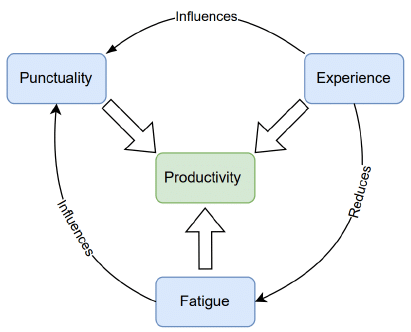
o The new human behavior model now has three components: (1) experience–learning, which adjusts execution times along the mastery curve; (2) punctuality–reliability, capturing delays and operator consistency; (3) fatigue–rest, modulating performance according to effort. Calibrated for Origami and Simbot maintenance use cases. The model was simulated and implemented in the sim-optimization process.
- NetLoPy Library & Sim-Optimization
o We developed NetLogopy, an open-source library that directly connects Python to NetLogo.
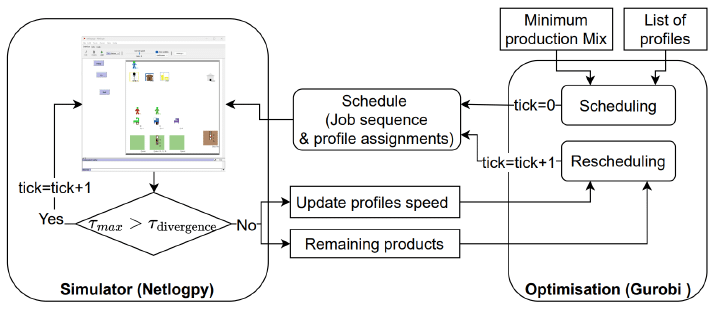
o This allowed us to leverage Python’s powerful optimization libraries, including the Gurobi solver, while retaining the flexibility of NetLogo’s multi-agent simulation. We also automated bidirectional data synchronization, which significantly reduces computation times and speeds up sim-optimization loops. - Sim-optimization mechanism for dynamic scheduling
o We developed an event-driven sim-optimization mechanism that combines, via NetLogopy, the NetLogo multi-agent simulator and the Gurobi MILP solver: the simulation executes the initial schedule, continuously calculates an overall delay indicator (τ_divergence) based on the difference between actual and planned times, and only restarts optimization when this delay exceeds a threshold τ_max; the solver then generates a new schedule (job sequence and operator/profile reassignment) which is immediately fed back into NetLogo to resume the simulation. This “on-demand” strategy drastically reduces calls to Gurobi, cuts calculation time by a factor of ten compared to systematic recalculation, and thus enables dynamic, near real-time scheduling while taking into account the three behavioral components (experience-learning, punctuality-reliability, fatigue).
- Scientific dissemination
o In terms of scientific dissemination, the project has achieved solid visibility: we have already published a reference article in the International Journal of Production Economics (2024) and presented our results at three A-level international conferences (IFAC MIM 2022, IEEE ICTMOD 2024, Simulation Workshop 2025) as well as at the SAGIP 2024 national congress; at the same time, four new manuscripts are under review or in the process of being submitted. In total, this brings the recent tally to five journal articles (including one published) and five conference papers, ensuring a balanced distribution between high-impact journals and targeted conferences, and positioning CESI LINEACT and the AntiHPert consortium as recognized players in behavioral modeling and dynamic scheduling. - Training & development
o In terms of training and knowledge transfer, the project enabled the defense of a doctoral thesis on hybrid modeling of operator behavior, the supervision of four introductory research internships at CESI and four internships at ESIGELEC, and the creation of an open multimodal database. At the same time, the community benefited from the extension of Python tools thanks to the open-source publication of NetLogopy, thus facilitating the implementation of the simulation-optimization gateway. - Editing of the suite: AntiHPert+ project
o To ensure the future of AntiHPert, we have designed AntiHPert+, an Industry 5.0 project that combines dynamic scheduling, explainable AI, and collaborative humanoid robots to optimize production while placing the operator at the center. It is structured around five areas: advanced data collection, predictive behavior modeling, disruption anticipation, robotic intelligence, and ethical governance. To finance it, we have examined several European calls for proposals—Interreg and Horizon Europe programs (Digital-Industry clusters, EIC Pathfinder, etc.)—and sought the support of funding agencies such as Zab. In order to finance it, we examined several European calls for proposals—Interreg and Horizon Europe programs (Digital-Industry clusters, EIC Pathfinder, etc.)—and sought the support of project development firms such as Zabala and Futuris. Despite these efforts, no call for proposals fully matched our scope before March 31, 2025. We are therefore continuing to monitor the situation with these partners in order to position AntiHPert + for the new Horizon Europe windows that have been open since June 2025, keeping the consortium mobilized and the application ready to be submitted as soon as a suitable opportunity arises.
These actions consolidate AntiHPert’s scientific and technological deliverables while paving a clear path toward AntiHPert+, ensuring the sustainability of collaborations and the industrial transfer of results.