C2A: Campus AERO Adour, training in low-carbon aircraft skills

- Partners: UIMM Occitanie Adour (project leader), Académie Industrielle HaPy, Aéropolis, DAHER AEROSPACE, Pôle Formation Adour, SAFRAN HELICOPTER ENGINES, TARMAC AEROSAVE, Tarbes University of Technology, CESI
- Objective: to train 60 students over four years and raise awareness among a wide audience
- Funding: AMI Skills and Jobs of the Future – France 2030
- Project duration: 2025–2029
Aeronautics is a strategic sector in France, creating jobs and driving innovation. But it also faces a major challenge: drastically reducing its carbon footprint to meet climate change challenges.
The C2A (Campus AERO Adour) project, supported by France 2030 as part of the AMI Compétences et métiers d’avenir (Skills and Jobs of the Future) initiative, was designed to meet this challenge. Its ambition is clear: to prepare students, teachers, and employees with the skills needed to develop and support low-carbon aircraft.
A structuring project for the aerospace industry
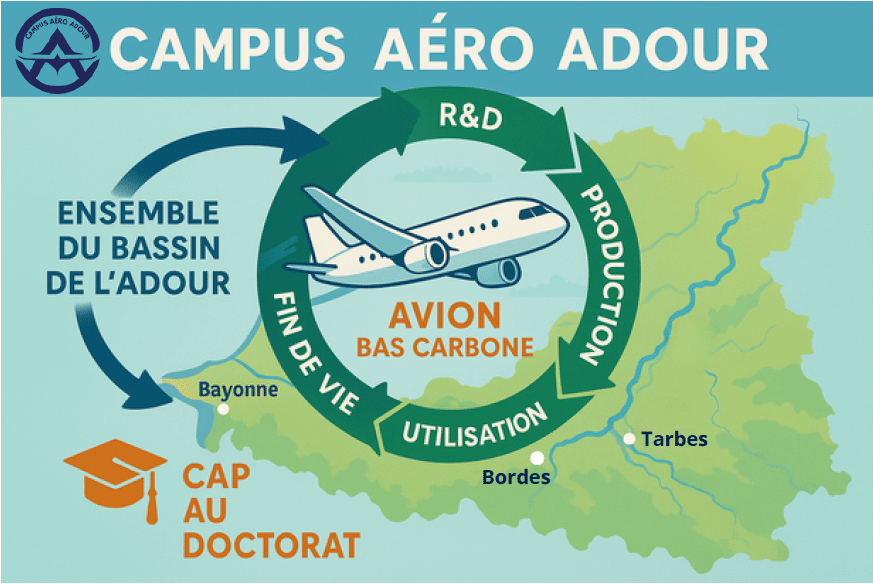
C2A is a structuring project that brings together a large consortium of industrial, academic, and regional stakeholders. Its aim is to become a genuine training and educational innovation platform dedicated to the transition of the aeronautics sector.
In concrete terms, the project is structured around several areas of focus :
- The creation of contextualized educational content based on real-life cases from the aeronautics sector. This content allows students to learn in situations that closely resemble real-world industrial scenarios.
- The design and deployment of active teaching sequences inspired by real-life cases from the aeronautics sector and using artificial intelligence and virtual/augmented reality. These immersive tools offer the possibility of simulating complex environments, practicing technical skills, and visualizing systems that are difficult to reproduce in real-life conditions.
- The implementation of high-level research projects, including two doctoral theses. This research focuses on key themes: collaborative XR architecture for training and operator assistance, and the use of big data applied to low-carbon aircraft.
- Support for teachers and trainers in integrating these new teaching approaches to ensure effective and sustainable deployment.
C2A is not limited to simply updating content. It is a comprehensive project that combines initial training, applied research, educational innovation, and regional collaboration to respond to a major industrial transformation.
Project objectives
- Prepare a new generation of bachelor’s and master’s degree holders with skills related to low-carbon aircraft.
- Train 60 students over four years through immersive and contextualized programs.
- Create innovative educational content integrated into CESI courses and tailored to the needs of manufacturers.
- Contribute to the attractiveness of aeronautical professions among young people through career guidance and information events, including a focus on diversity.
Key actions
- Design of immersive AR/VR teaching modules applied to aeronautical industrial processes.
- Deployment of active training sequences integrated into CESI courses and directly linked to low-carbon aircraft challenges.
- Development of training content on big data processing, essential for understanding and optimizing aircraft performance.
- Organization of information and awareness-raising events to attract new audiences and promote diversity in the sector..
Impacts for the future
- A skilled workforce prepared for ecological and technological transformations in aeronautics.
- Immersive teaching tools that make training more attractive, practical, and effective.
- A replicable model for other industrial sectors undergoing transition.
- The direct contribution of CESI and its partners to France 2030’s ambitions for energy and industrial transition.